Technology
AA Batteries vs Rechargeable Smart Lock Batteries
By GwayLock · Published
Compare replaceable alkaline cells and specified rechargeable lithium packs. Check battery chemistry, approved charging, emergency power and maintenance before choosing a lock.
Choose a smart lock's approved power system, not just the largest capacity number. AA and AAA describe cell sizes, not a universal chemistry or voltage specification. A lock designed for alkaline cells and a lock designed for a particular rechargeable lithium pack require different maintenance and charging arrangements.
Do not substitute rechargeable cells or a different lithium pack simply because they physically fit. Follow the exact model's battery specification and manual, including its approved charger and emergency-power instructions.
Two maintenance arrangements
Replaceable cells let the operator keep an approved spare set. A specified rechargeable pack instead needs an agreed charging and replacement process. Either approach requires access to the battery compartment and a practical response to low-power warnings.
On small screens, swipe across the table to compare all models.
| Check | Specified alkaline cells | Specified rechargeable pack |
|---|---|---|
| Replacement | Correct size, chemistry, count and installation | Correct model, voltage, connector and pack specification |
| Maintenance | Keep an approved fresh set and replace as instructed | Follow the approved charging and pack-replacement process |
| Capacity claim | Ask for the conditions behind any life estimate | mAh alone does not establish runtime on a different lock |
| Emergency power | Confirm the port and procedure separately | Do not assume emergency input charges the pack |
| Project handover | Record cell type and battery access | Record pack part number, charging method and support plan |
Read the chemistry requirement carefully
Yale's published guidance for its New Zealand smart and digital locks recommends alkaline cells and advises against substitutes for those products. This is a useful example of why the device manual matters; it is not a prohibition on all rechargeable smart locks. A GwayLock model designed for a specified lithium pack must be evaluated using that pack's own instructions.
Four catalogue examples
The current GwayLock catalogue lists different power arrangements for different platforms. Keep those values with their model identifiers. They are source specifications, not measured battery-life results.
On small screens, swipe across the table to compare all models.
| Model | Source-listed supply | What still needs confirmation |
|---|---|---|
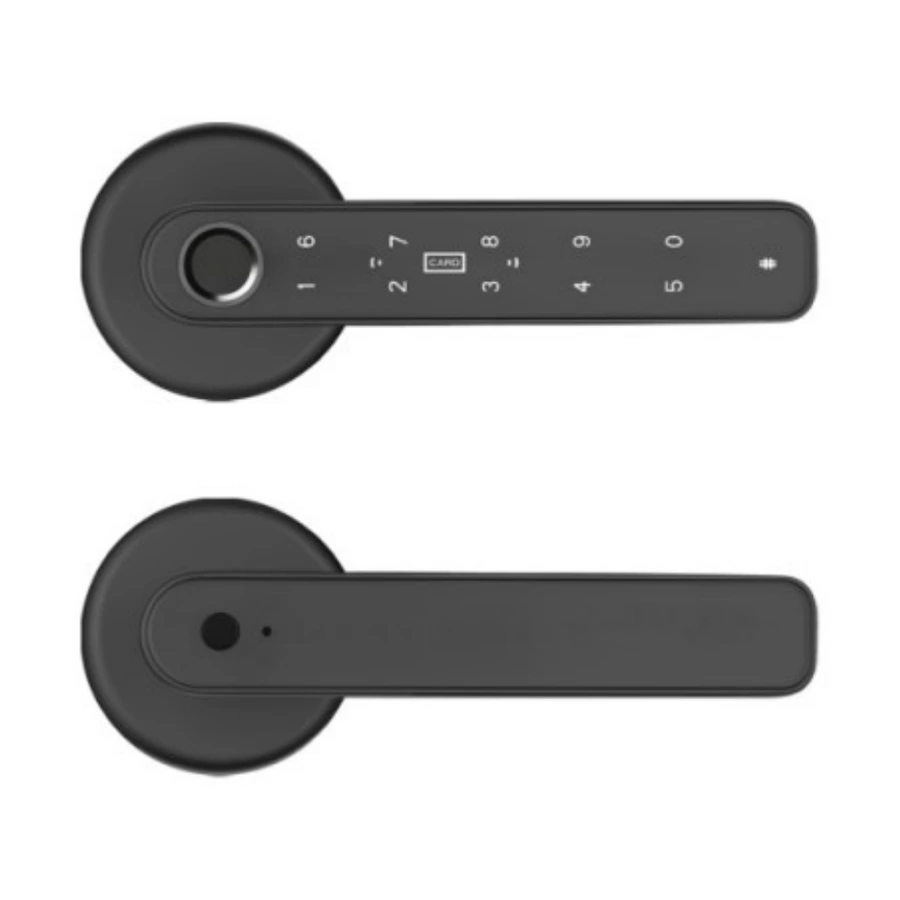
| DS01 | 6 V; four AA alkaline batteries | Approved cells, replacement instructions and low-power behavior |
| 196 | 6 V; four AAA alkaline batteries | Approved cells and maintenance procedure |
| HP-03 | 4200 mAh lithium-ion battery | Supplied pack, approved charging and service instructions |
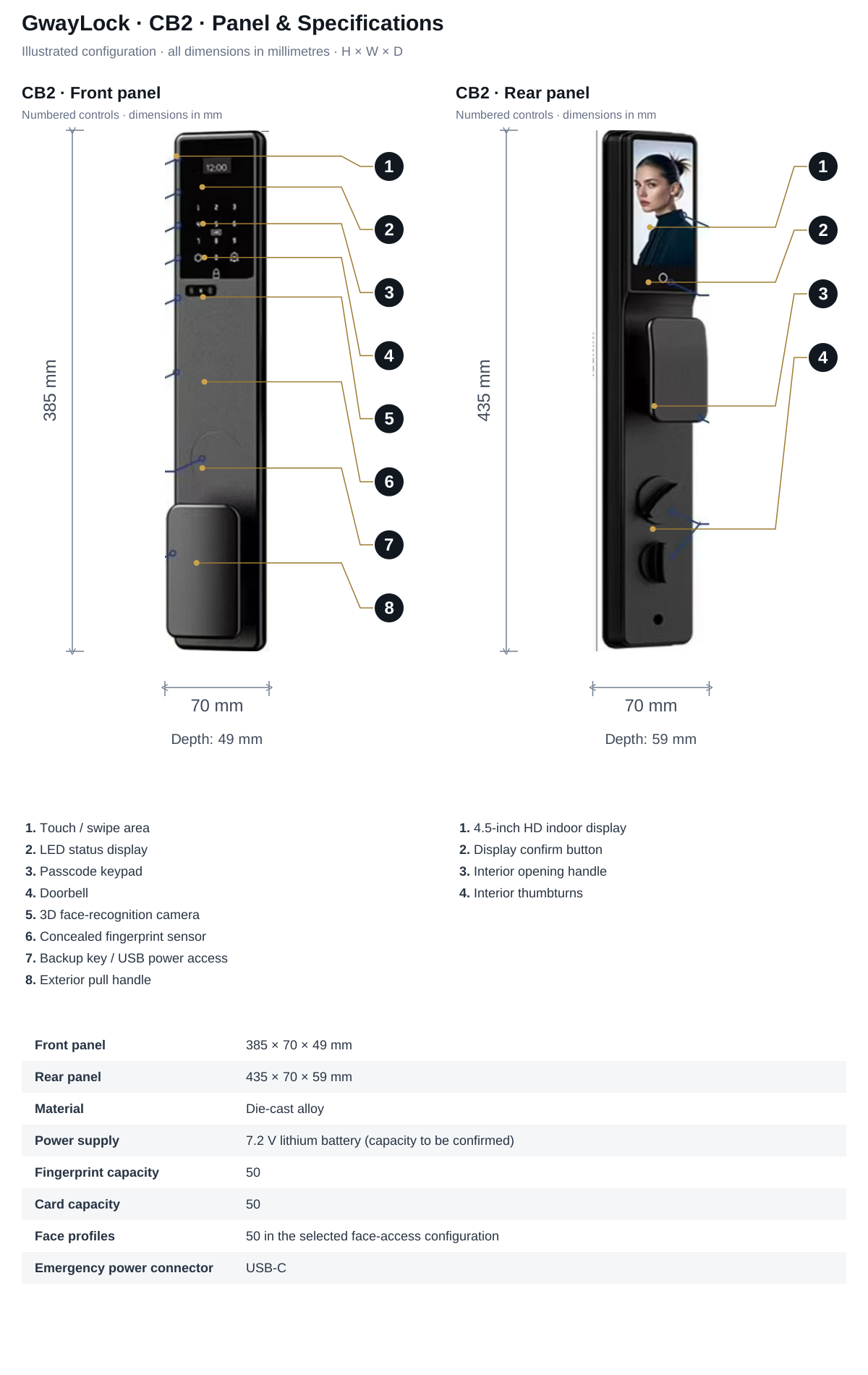
| CB2 | 7.2 V lithium battery; capacity not stated | Exact pack, capacity, charging and replacement details |
Do not promise runtime from capacity alone
A rechargeable pack's capacity cannot be compared directly with an unspecified set of AA cells to predict service intervals. The complete lock, its access workload, motor behavior, connected functions, environment and installation all belong in the evaluation. Request the conditions behind a supplier's estimate, then record your own representative sample observations. Do not advertise a fixed number of months without supporting evidence for that configuration.
Emergency power is not necessarily charging
An external emergency-power connector may temporarily supply the electronics for an authorized opening; that does not establish that it recharges the internal battery. CB2's catalogue identifies USB-C emergency power. Confirm permitted input and the documented sequence for that exact unit. Use only approved equipment, do not charge non-rechargeable cells, and follow the manufacturer's instructions for any damaged or abnormal battery.
Make the maintenance plan part of selection
For a project, decide who receives low-battery warnings, who can reach the battery compartment, where approved spares are kept and how service is recorded. Confirm the support and replacement supply for the chosen configuration before bulk orders. A clear maintenance plan can matter more than the word rechargeable on a product card.
Sources and scope
Product information follows the referenced catalogue pages. Confirm the selected configuration and installation before ordering.
External references explain general principles, test scopes or products from other manufacturers. They do not establish performance, compatibility or certification for the selected GwayLock model.
- Yale: recommended batteries for its smart and digital locks (model/market-specific advice)
- Yale: installation and model-dependent emergency power
- DS01: current catalogue, page 44
- 196: current catalogue, page 8
- HP-03: current catalogue, page 78
- CB2: current catalogue, page 73
- CB2: updated English panel, power and dimension sheet
FAQ
Frequently Asked Questions
Can rechargeable AA cells replace the specified alkaline batteries?
Use only the battery chemistry and specification permitted by the exact model's manual. Physical fit alone does not establish electrical compatibility or correct low-battery behavior.
Does a larger mAh number guarantee longer smart-lock battery life?
No. Compare the approved power system, lock workload, connected functions, installation and documented test conditions. A capacity label by itself does not establish runtime for a different configuration.
Keep reading
Related Articles
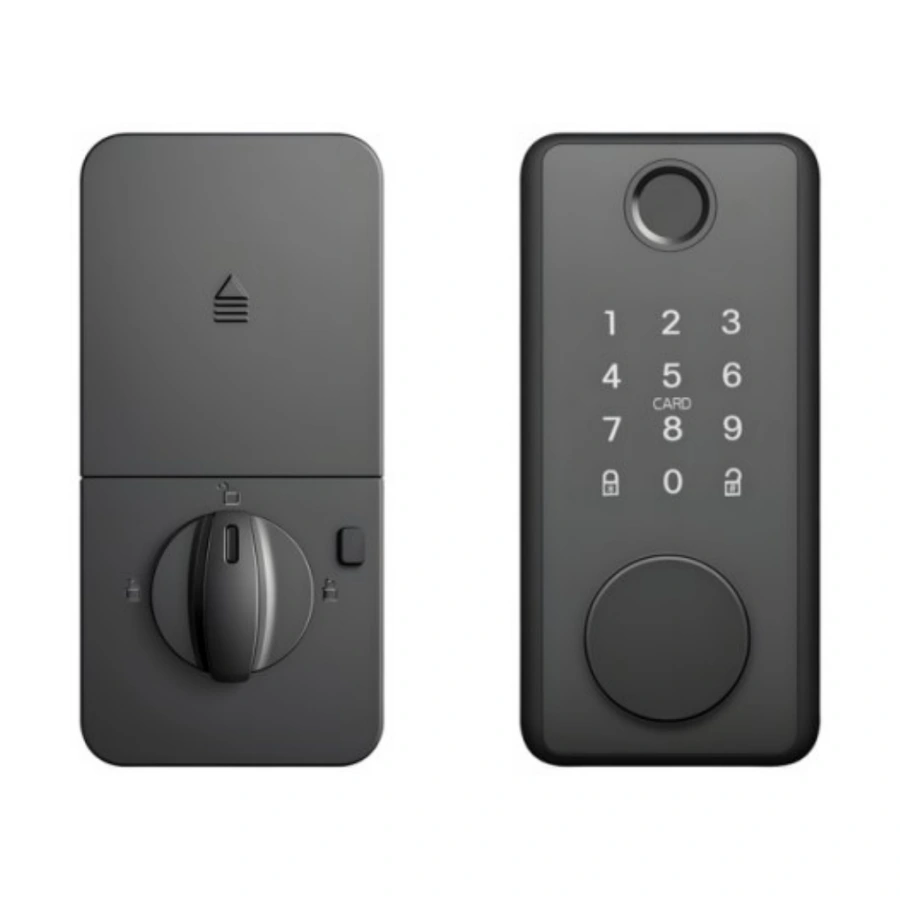
Do Smart Locks Work Without Wi-Fi or Power?
Separate a Wi-Fi outage, a household power cut and an empty lock battery. Learn what to check for local access, remote functions and emergency entry.
Oct 30, 2026
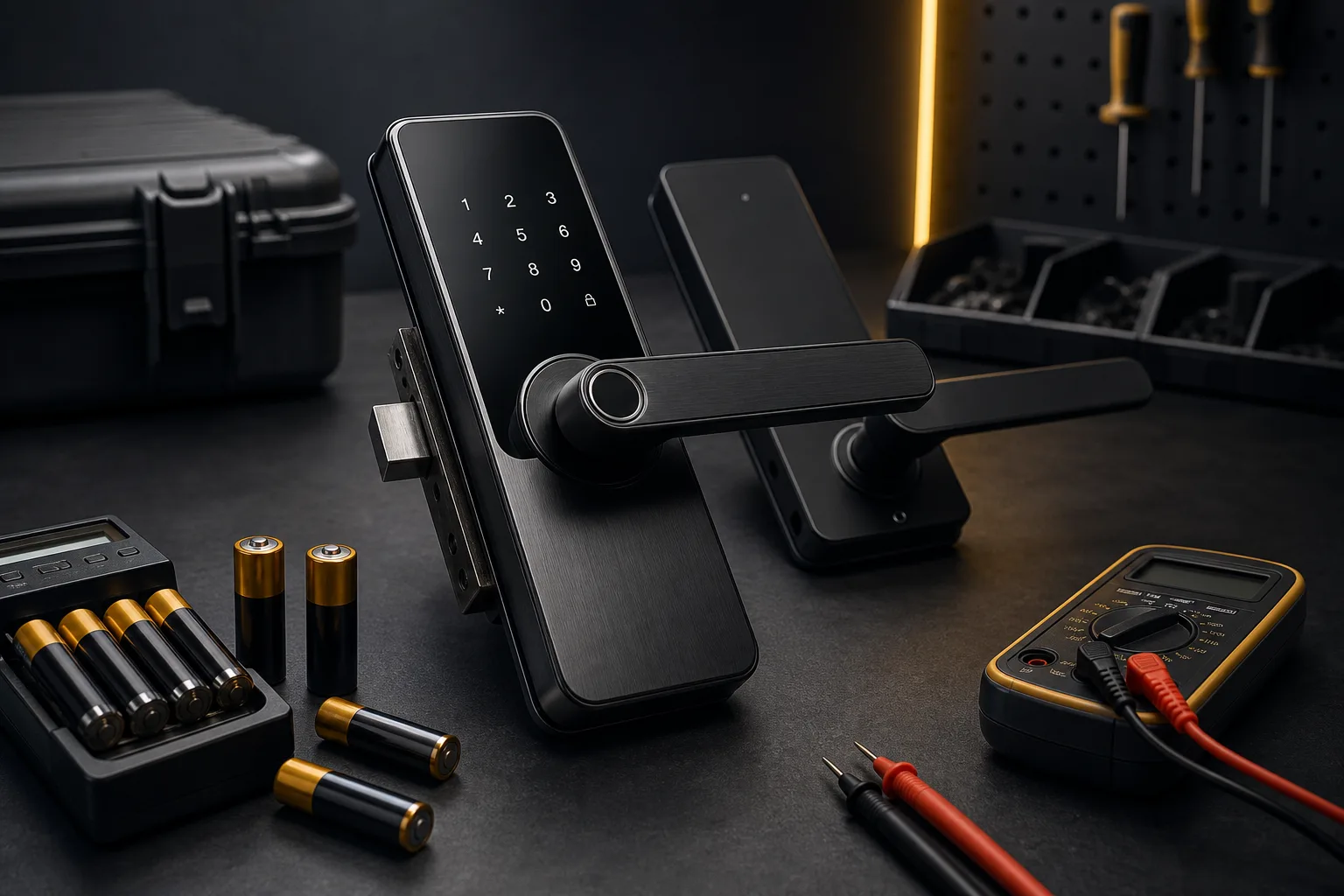
Why Smart Lock Battery Life Fails: What B2B Buyers Should Check
Battery complaints can damage a smart lock brand quickly. Learn what importers and distributors should check before sample approval and bulk orders.
Jun 22, 2026
Smart Lock QA & QC: Inspection Checklist for Buyers
Plan smart lock QA and QC with model-specific door-fit, power, access and app checks. Download an editable inspection record for samples and pre-shipment review.
Jun 4, 2026
Need supplier support?
Discuss your smart lock OEM/ODM project with GwayLock
Send us your target market, door type, preferred app platform and customization needs. Our team will help you evaluate suitable models and prepare a practical quotation.